Growth AI · for leadership teams

See where the business is heading. Decide what to change.

See how a Growth Action could change your outlook. Compare it with your current course, agree on a plan, then track the results.

Company outlook Illustration, no real figures
ActualCalculatedStart3 months6 months12 months
  • With the plan
  • Range of the cases calculated
  • If nothing is done
  • Actual, as recorded
A range of calculated cases, checked against what is later recorded. Illustration only, not a customer result.

Company facts you confirm, with unknowns left visible

Growth Actions chosen from the full method

A forecast shown as a range, never a promise

Actual progress read against what was saved

A familiar situation

A capable team.
A busy business.
An unclear next move.

Growth AI is most useful when leadership is capable and committed, but not yet agreed on what is limiting growth.

Bring honest answers, the evidence you already have, and a leader ready to act. Unknowns are a valid starting point.

Effort spread across too many priorities
Good ideas compete for time and attention.
Different views of the bottleneck
Teams see different parts of the problem.
Decisions made without the consequences in view
A plan is agreed before anyone has seen what it is expected to change, what it costs, or what it rests on.
What your team gets

Your forecast, Growth Actions and results.

01 / Understand

Growth Blueprint

Know where to focus next, why it deserves attention, and what to check before committing your team.

  • Bring different views of the business into one clear picture
  • Choose a growth priority backed by your answers and evidence
  • See what is known, what is missing and what needs checking
  • Built on six layers of the business and 24 dimensions, not a single workshop exercise
Explore the method →
Growth Blueprint Illustrative demo
STRATEGYCUSTOMERVALUESTORYENGINEGROWTH

Overall score

243 of 360

Structured

A summary of your recorded answers, not a measure of business performance.

  • StrategyWhere you compete and why48 of 60
  • CustomerWho you serve and how they decide36 of 60
  • ValueWhat you mean to the market42 of 60
  • StoryThe narrative that carries your brand45 of 60
  • EngineContent, channels, conversion, and AI33 of 60
  • GrowthMetrics, sprints, and compounding39 of 60

An example of bringing the business into one picture. These scores help choose what to investigate; they do not measure business performance.
Synthetic demo company. Scores are illustrative, not a customer result.
02 / Decide

Company outlook and Growth Actions

One forecast for the company with its Growth Actions inside it. See the current course beside the plan, how wide the range is, and what each action is assumed to change.

  • Operating profit, cash and delivery capacity over twelve months, read at 3, 6 and 12
  • Every input marked as observed, assumed or not in the calculation
  • Recalculate the plan without one action to see how much rests on it
  • Each action carries a suggested call: proceed, adjust first, start later, test first or not now

A forecast shows what would follow if the reviewed assumptions held. It is not a prediction and states no probability. Leadership makes the call.

Who does what →
Inside the CEO dashboard Worked example · fictional company
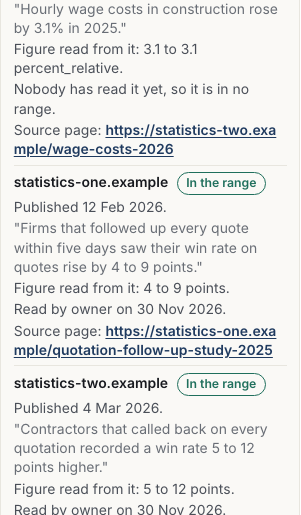
Quotation follow-up in the signed-in dashboard, with low, middle and high operating-profit effects and reviewed sources.

Should we follow up on more quotations?

Where we stand
The company’s confirmed figures put operating profit on its current course at 302k for the plan period.
What could change
Three reviewed sources support a range for the change in win rate. Applying that range to this company gives a modelled profit increase of 47k to 181k.
What happened
Leadership saved the plan. The sales team recorded when follow-up began. At the next close, the owner entered 28k in monthly operating profit and compared the updated outlook with the original.
Signed-in dashboard excerpt with simulated accounts and offline example sources. The monthly result updates the outlook; it does not establish how much the action earned.
03 / Execute

90-Day Growth Plan

Give your team a shared direction for the next 90 days, with clear ownership and a way to see whether the work is helping.

  • A shared plan: one outcome, an owner, a deadline and a measure
  • Know what to do first and what comes next
  • Weekly updates, completion confirmed with evidence, and results measured: three separate records
  • Review progress and decide what to continue or change
See how the 90-Day Plan works →
90-Day Growth Plan Actual demo product view
Demo plan showing a repeat-purchase outcome, owner, stated baseline and retention actions
Synthetic demo plan. An example of the structure, not a customer result.
04 / AI Growth Alignment

Your plan. Your team. Your AI.

Give your team’s AI the business context and approved priorities it needs to support the work that matters. Bring progress back into one company view.

  • Help people work toward the same business goals
  • Use AI to prepare questions, work and evidence updates
  • Review recorded progress in a monthly CEO brief

Connected AI and the monthly CEO brief are being prepared for a guided rollout. People review proposed updates and retain control of decisions. The downloadable AI Launch Kit remains available.

Explore AI Growth Alignment →
One connected growth process How the offer works

Shared direction

Understand your business

Agree your 90-day plan

Brief your team’s AI

Review proposed updates

Read your monthly CEO brief

The team asks
Help me prepare this week’s work against my assigned priority.
A person reviews
Check the AI’s proposed evidence update before it becomes a progress record.
The CEO reviews
What has been recorded, what is missing and where do we need to decide?
Illustrative workflow, not a customer result or a live product screenshot. Connected access is limited by role and does not train a model. Growth AI does not collect AI conversations; sharing inside your AI service follows its settings.
Who does what

The routine work is handled. The judgment stays with people.

  1. The system and AI

    Handle the routine work

    The same assessment answers produce the same scores. The forecast updates as company figures, reviewed evidence and progress change. AI prepares evidence for review. Leadership decides what to do.

  2. Your team

    Say what is feasible

    The people on an action add what they know, raise a capacity objection, or flag a concern in confidence. They report progress each week.

  3. Your consultant

    Advises on the exceptions

    Reviews the assumptions behind a forecast, challenges weak evidence and advises where the method does not give a clear answer. Not a sign-off on every step.

  4. Leadership

    Decides

    The calculation suggests a call and shows its reasons. You decide whether to proceed, adjust, wait, test or stop, and the reason is kept with the decision.

What the forecast can tell you, and what it cannot

  • It shows what follows if the stated assumptions hold. It does not predict what will happen and gives no likelihood.
  • It models price, win rate, enquiries and delivery capacity. An action that works another way is shown as outside the calculation.
  • The company outlook covers twelve months. Beyond that an action shows its direction only.
  • Figures go out of date. When they do, the forecast is marked and draws no conclusion until they are refreshed.
  • Finishing an action is not a result. A result is a measurement, recorded separately.
Customer stories

What changed when leadership agreed what was holding growth back.

B2B software, about 35 people

More leads were not the answer

Situation
Marketing spend had doubled over two years while revenue grew far less. Leadership believed it needed more leads.
What was in the way
No defined target market. Asked who the primary customer was, the leadership team gave four different answers.
Choose the customers you are built for
Ranked customers by margin, retention and sales cycle, then chose two segments. Positioning and sales materials followed that focus. A written decline rule, adjusted compensation and a weekly fit review kept the team aligned.
Observed result
Acquisition cost fell and the win rate on well-fitting accounts rose. The team held fewer sales conversations, and better ones.
Direct-to-consumer brand

Growing, but starting from zero every month

Situation
Revenue was growing, but paid acquisition had become the largest cost in the business, margin was eroding and the share of returning customers was falling.
What was in the way
Retention had no owner, no programme and no measure. Nobody could say why customers did not come back.
Make retention someone’s responsibility
Named one owner and a weekly retention measure. Added exit surveys, weekly customer calls, replenishment reminders and a second-purchase offer timed to the buying cycle. Returning-customer revenue became part of every weekly review.
Observed result
Repeat purchase rose through the quarter and customer lifetime value recovered, so the same advertising budget bought customers worth more.
Professional services, about 20 people

Not too expensive, priced on cost

Situation
Strong client results and referrals, yet proposals were discounted before clients pushed back and profit was thin. The firm believed it was too expensive.
What was in the way
Fees were set from cost and day rates, never from the outcomes the work produced, so conversations turned on price.
Price the outcome, not the hours
Documented the outcomes of twenty engagements and rebuilt three fixed-price offers around that value. Proposals led with the client’s outcome. A quarter of consistent pricing and a win-loss log tested the change.
Observed result
Margins improved as the new offers held their price, and deals turned on fit rather than rate. Two clients accepted fees the firm would previously have discounted.

A selection of real engagements from Growth AI's development period. Companies are anonymised. Results are observations from the engagement; no figures are published.

Trust

Rigorous where it matters.

Consistent scoring
The same answers give the same result. AI cannot change your recorded result.
Visible unknowns
Missing information stays visible, rather than being filled in.
Reviewed answers
Your Blueprint keeps the version your company reviewed and confirmed.
Leadership keeps the decisions
You decide the priority, the plan and what your team authorises.
How we handle data →Common questions
Who needs to take part?

One leader can complete the work. New interviews also let you request a specific colleague's input where their knowledge is needed.

What if we do not know an answer?

Say so. Unknown answers stay visible, and the Blueprint shows where evidence is missing rather than guessing.

Is the forecast a prediction?

No. It shows a range of calculated cases that follow from your recorded figures and stated assumptions. It gives no probability, and it is checked later against what you actually record.

Do we have to use AI?

No. The Blueprint and plan stand on their own. The AI Launch Kit and guided connected AI option support the same plan; you choose whether to use them.

Kalle Sarraj, Founder and CEO of Growth AI

Built by Kalle Sarraj, Founder and CEO, on the Growth Operating System Framework from his book The Digital Growth Playbook. About the method and its founder

Next steps

What does getting started look like for your business?

Talk to our team →

Tell us the growth question in front of your leadership.

Partners

Help more businesses move forward.

Two ways to bring Growth AI into the work you do with growing companies.

For incubators and accelerators

Program Partner

Give founders a shared method to find their growth priority, focus mentor time and turn support into a practical 90-day plan.

Explore Program Partner

For consultants, advisors and growth strategists

Certified Partner

Give your advice a clear structure clients can follow, from understanding their business to agreeing priorities and reviewing progress.

Explore Certified Partner